
Save books, track your reading goal, and leave reviews. Free to join.
Create free account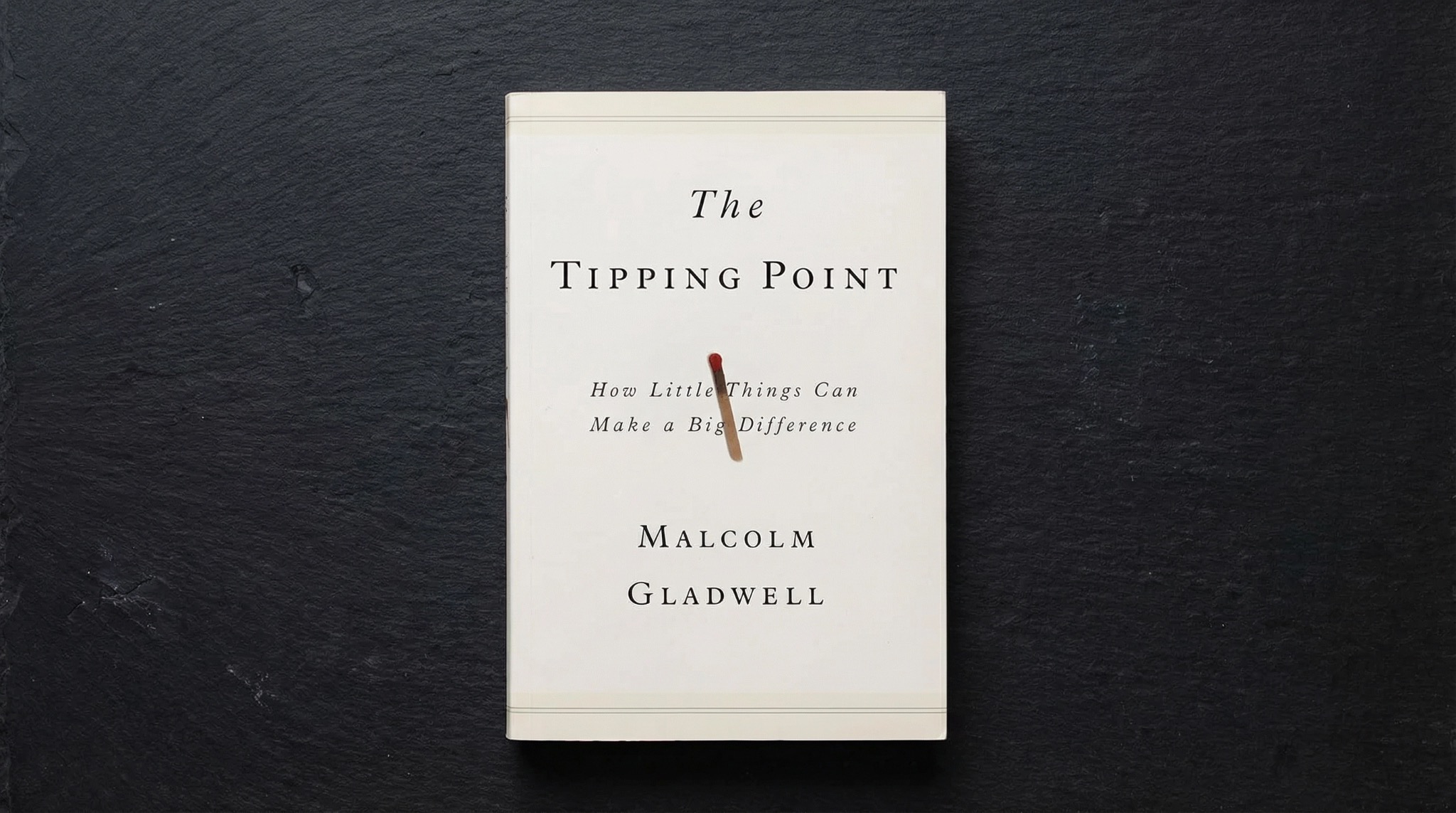
"Malcolm Gladwell reveals the hidden mechanics behind why ideas, products, and behaviors suddenly explode into mass popularity, and how small, targeted actions can engineer that moment deliberately."
Get This Book
Available on Amazon
Buy on AmazonListen on AudibleAs an Amazon Associate I earn from qualifying purchases.
Our Verdict
RecommendedFull Review
The Tipping Point explores why ideas, products, behaviors, and messages spread like epidemics, reaching a critical moment where they surge into mass popularity. Malcolm Gladwell argues that social change follows predictable patterns, not random chance. Small, precisely targeted actions create outsized impact, much like a single virus particle triggers widespread illness.
Gladwell examines real-world epidemics: Hush Puppies shoes exploding from obscurity to fashion staple, New York City's dramatic crime drop, teenage smoking rates, and Sesame Street's educational reach. Each case reveals common mechanics driving sudden shifts. The book challenges gradualist assumptions. Change happens abruptly at the tipping point, the threshold where momentum becomes unstoppable.
Understanding these mechanics allows deliberate engineering of spread. The framework reveals why some efforts gain traction while others fade unnoticed.
The Law of the Few
Gladwell identifies three rare personalities driving epidemics: Connectors, Mavens, and Salesmen. Connectors bridge social worlds, possessing vast networks across industries and communities. Their casual introductions spark connections ordinary people miss. Paul Revere's midnight ride succeeded because his connector status ensured wide dissemination.
Mavens hoard and share information obsessively. They research deeply, recommend passionately, and persuade through credibility. Consumer Reports readers embody this type, influencing purchases through trusted expertise. Salesmen wield charisma, compelling behavior change through nonverbal persuasion. Their enthusiasm proves contagious.
Together, these few account for disproportionate spread. Gladwell traces Hush Puppies revival to New York designers, club kids, and stylists, each amplifying through personal networks. The principle scales beyond fashion. Ideas spread through human multipliers, not mass broadcasts.
The Stickiness Factor
Stickiness describes content that compels attention and memory. Gladwell dissects Sesame Street and Blue's Clues, showing deliberate design creates enduring impact. Repetition, engagement, comprehension turn passive viewing into active learning. Children's television succeeded because stickiness drove parental loyalty.
Newsletters reveal similar mechanics. Short, surprising, concrete, credible, emotional, story-driven messages stick. Gladwell contrasts forgettable corporate memos with viral urban legends persisting decades. Structure determines retention.
Messages engineered for stickiness bypass conscious filters. Simple reframing transforms mundane information into compelling narrative. Memory creates the foundation for action and sharing.
The Power of Context
Environment shapes behavior more than personality or disposition. Gladwell invokes Broken Windows theory, where New York cracked down on graffiti and turnstile jumping, triggering crime collapse. Minor disorder signaled permissiveness; swift response restored norms.
Subway suicide rates dropped when platform lighting and signage altered perceived context. Small environmental tweaks yielded massive behavioral shifts. The rule of 150 limits group cohesion; beyond Dunbar's number, social bonds weaken. Gore-Tex thrives through autonomous 150-person plants.
Context proves more malleable than character. Minor environmental adjustments trigger disproportionate responses. Situational cues govern individual choices more than internal resolve.
Case Studies in Epidemics
Gladwell dissects smoking's teenage appeal. Peer pressure, rebellion, stress relief create stickiness. Connectors distribute samples, mavens debunk health myths, salesmen model coolness. Contextual factors like depression vulnerability amplify spread.
Hush Puppies revival traces to East Village tastemakers. Designers spotted clearance rack stock, sparking trend. Club promoters amplified through parties. Fashion editors validated. Law of the Few plus stickiness overcame market saturation.
New York crime drop combined policing innovation, lead paint removal, abortion legalization. Multiple small causes converged contextually. Gladwell warns single explanations mislead. Epidemics demand systems thinking.
Syphilis outbreak among Baltimore teens showed contextual sensitivity. Broken Windows applied to social disorder predicted spread. Environmental cues signaled opportunity.
Engineering Tipping Points
Gladwell outlines deliberate creation. Identify connectors within target networks. Craft sticky messaging through testing. Manipulate context through environmental design. Monitor leading indicators signaling threshold approach.
Sesame Street succeeded through rigorous formative research. Episode drafts tested with children, refined iteratively. Content creators A-B test concepts with focus groups. Messages iterate based on audience reactions.
Scale matters. Little causes amplify through right multipliers. Satisfied influencers generate organic buzz. Timing proves critical. Cultural readiness determines receptivity. Gladwell traces Paul Revere's success to pre-existing militia networks primed for action.
Limits and Evolutions
Gladwell acknowledges complexity. Not all epidemics follow identical paths. Cultural differences shape receptivity. Over-reliance on single levers fails. Recent critiques note crime drop oversimplification.
The framework endures because it reveals pattern recognition. Random tactics fail; leverage points succeed. Sponsorship spread follows predictable mechanics despite surface variation.
Modern digital amplification accelerates tipping. Social media multiplies connectors exponentially. Viral coefficients replace Dunbar limits. Core principles hold: few, stickiness, context.
Final Thoughts
The Tipping Point reveals social change mechanics with journalistic precision. Malcolm Gladwell proves small levers create massive momentum. The framework equips readers to engineer spread deliberately. Epidemic mastery separates influencers from spectators.
Enjoyed this review?
Subscribe for more curated book recommendations and insights from the 200 books journey.
No spam. Unsubscribe anytime.
Get This Book
Available on Amazon
Buy on AmazonListen on AudibleAs an Amazon Associate I earn from qualifying purchases.
Our Verdict
RecommendedAlso Worth Exploring
Tools and services I use and recommend.
Some links are affiliate links. I only recommend things I genuinely use.
Get Book Recommendations
Weekly picks from the 200 books journey.
No spam. Unsubscribe anytime.
Keep Reading
Read Next
More from Science & Ideas worth your time


Reader Reviews
No reviews yet. Be the first to share your thoughts!