
Save books, track your reading goal, and leave reviews. Free to join.
Create free account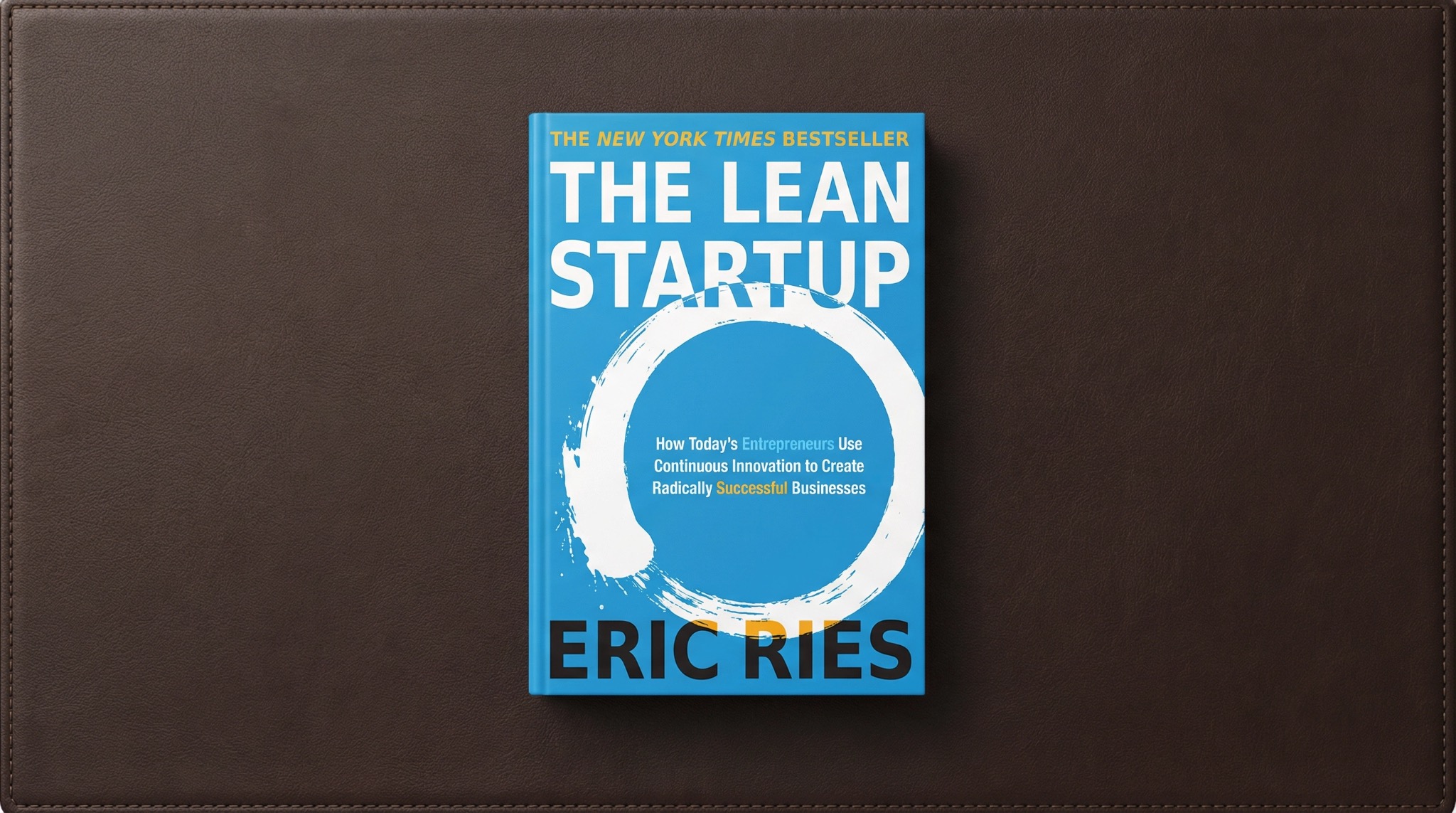
"The goal is not to execute a fixed plan perfectly. The goal is to learn quickly what customers actually want before time and money run out."
Get This Book
Available on Amazon
Buy on AmazonListen on AudibleAs an Amazon Associate I earn from qualifying purchases.
Our Verdict
RecommendedKey Takeaways
- Startups should be run as experiments, not as fixed plans.
- The goal is validated learning — reducing uncertainty — not just activity or output.
- MVPs exist to test assumptions as quickly and cheaply as possible, not to impress.
- Pivots should be evidence-based, not driven by fear or ego.
- Vanity metrics can hide real problems; actionable metrics that change decisions are what matter.
- Innovation accounting helps track learning in uncertain environments where traditional metrics mislead.
- The framework applies to any organization trying to create something new under uncertainty.
Full Review
Building With Speed, Learning, And Discipline
The Lean Startup is Eric Ries's framework for building new businesses under extreme uncertainty. Rather than treating a startup as a smaller version of a mature company, Ries argues that it should be managed like a scientific experiment. The goal is not to execute a fixed plan perfectly. The goal is to learn quickly what customers actually want before time and money run out.
What makes the book endure is that it speaks to more than startups in the narrow sense. Ries defines a startup as any organization creating something new under conditions of uncertainty, which means the lessons apply to new products inside big companies, side businesses, and ventures of all kinds. The book is fundamentally about how to reduce waste, shorten feedback loops, and make better decisions when the future is unknown.
Build, Measure, Learn
The core loop in The Lean Startup is Build, Measure, Learn. Instead of spending months perfecting a product based on assumptions, you build the smallest version that can test the idea, measure what customers do with it, and learn from the results. Then you repeat the process. The point is speed of learning, not polish for its own sake.
That approach changes the meaning of progress. In a traditional model, progress means you have built more features or finished a longer plan. In Ries's model, progress means you have reduced uncertainty. If a test proves that customers do not value the product the way you thought, that is useful information, not failure in the usual sense. You have learned something real before the costs became too high.
For operators, this is one of the book's most valuable lessons. It forces discipline around assumptions. A team can spend a long time working hard and still learn nothing if it is not testing the right thing. Ries pushes founders to turn beliefs into hypotheses and hypotheses into experiments.
The Minimum Viable Product
One of the most famous ideas in the book is the Minimum Viable Product, or MVP. This is not a sloppy prototype for the sake of being cheap. It is the smallest version of a product that can reveal meaningful customer behavior. The MVP exists to answer a question, not to impress anyone.
Ries is careful to distinguish between getting something out quickly and getting something useful out quickly. The point is to learn whether the value proposition actually works. If customers do not engage, convert, or return, the team needs to know that early. A well designed MVP can save years of wasted effort because it exposes whether the real problem is the product idea, the market, or the execution.
This is especially relevant for anyone launching in a crowded category. Companies often assume they need a fully formed product before learning from customers. Ries argues the opposite. You often learn more from a rough, well targeted test than from a polished launch that arrives too late to change direction.
Pivot Or Persevere
Another central concept is the pivot. A pivot is a structured change in strategy based on what you have learned. It is not random flailing. It is a conscious decision to keep the same basic mission while changing some key assumption about the product, market, or business model.
The book makes a strong case that many startups fail because they keep going long after the evidence says they should adjust. Founders get attached to the original idea. They read temporary interest as proof of product market fit. They confuse motion with validation. Ries wants teams to have the courage to say that the original strategy was wrong and to change before the runway is gone.
That does not mean every setback requires a pivot. Sometimes the right move is to persevere. The challenge is distinguishing between a bad idea and a hard execution path. The book's framework helps with that by tying the decision to evidence rather than ego. If the data supports the idea, keep going. If it does not, change course.
Validated Learning And Metrics
Ries is deeply skeptical of vanity metrics. Page views, likes, downloads, and other easy numbers can create the illusion of progress without telling you whether the business is actually working. The book argues that teams need actionable metrics, the kind that help you understand customer behavior and business health in a meaningful way.
Validated learning is the opposite of guesswork. It means proving something true about customer needs through real behavior, not just opinions. That might involve watching how users interact with a product, measuring retention, or testing different versions of a feature. The key is that the learning should change what the company does next.
This is a powerful corrective for many organizations, not just startups. Teams often drown in dashboards that make them feel informed while avoiding the harder question of whether customers are genuinely benefiting. Ries's framework insists that metrics must guide action, not just decorate a meeting.
Innovation Accounting
The book also introduces innovation accounting, a way of measuring progress in uncertain environments where traditional accounting does not tell the whole story. Early stage ventures are not supposed to look efficient in the same way mature businesses do. They are supposed to discover what works. Innovation accounting gives leaders a structure for recognizing that discovery process.
This means setting clear milestones around learning, testing, and iteration. A startup should be able to say what it believed, what it tested, what it learned, and what changed as a result. That creates accountability without forcing the company into fake precision. It also helps prevent teams from working for months without realizing they are moving in the wrong direction.
From an operator's perspective, this is one of the book's smartest ideas. It acknowledges that early stage work requires a different scorecard. If you measure a startup like a mature company too soon, you may punish the very experiments that are necessary for eventual success.
Why The Book Matters
The Lean Startup has had a huge influence because it gives founders a practical way to deal with uncertainty. It does not promise success. It promises better decision making. That is a more honest and useful claim. Most new ventures fail not because their founders lack passion, but because they spend too long building the wrong thing.
The book also helped shift startup culture toward experimentation, customer feedback, and faster iteration. That has become standard language in product and innovation teams across industries. Even where people do not follow the method precisely, they often think in Lean Startup terms. That alone is a sign of its impact.
For leaders, the deeper lesson is that learning should be built into the business model. If the company is not structured to learn quickly, it will likely waste time and capital. The Lean Startup is essentially a case for treating uncertainty as a design problem.
Final Thoughts
The Lean Startup changed how a generation of builders think about uncertainty. Its core insight, that validated learning beats assumed progress, is as relevant now as when it was written. For anyone building a product, launching a new revenue stream, or trying to move faster inside a large organization, the book provides a practical framework for reducing waste and increasing the odds of getting it right.
Enjoyed this review?
Subscribe for more curated book recommendations and insights from the 200 books journey.
No spam. Unsubscribe anytime.
Get This Book
Available on Amazon
Buy on AmazonListen on AudibleAs an Amazon Associate I earn from qualifying purchases.
Our Verdict
RecommendedAlso Worth Exploring
Tools and services I use and recommend.
Some links are affiliate links. I only recommend things I genuinely use.
Get Book Recommendations
Weekly picks from the 200 books journey.
No spam. Unsubscribe anytime.
Keep Reading
Read Next
More from Business & Leadership worth your time


Reader Reviews
No reviews yet. Be the first to share your thoughts!