
Save books, track your reading goal, and leave reviews. Free to join.
Create free account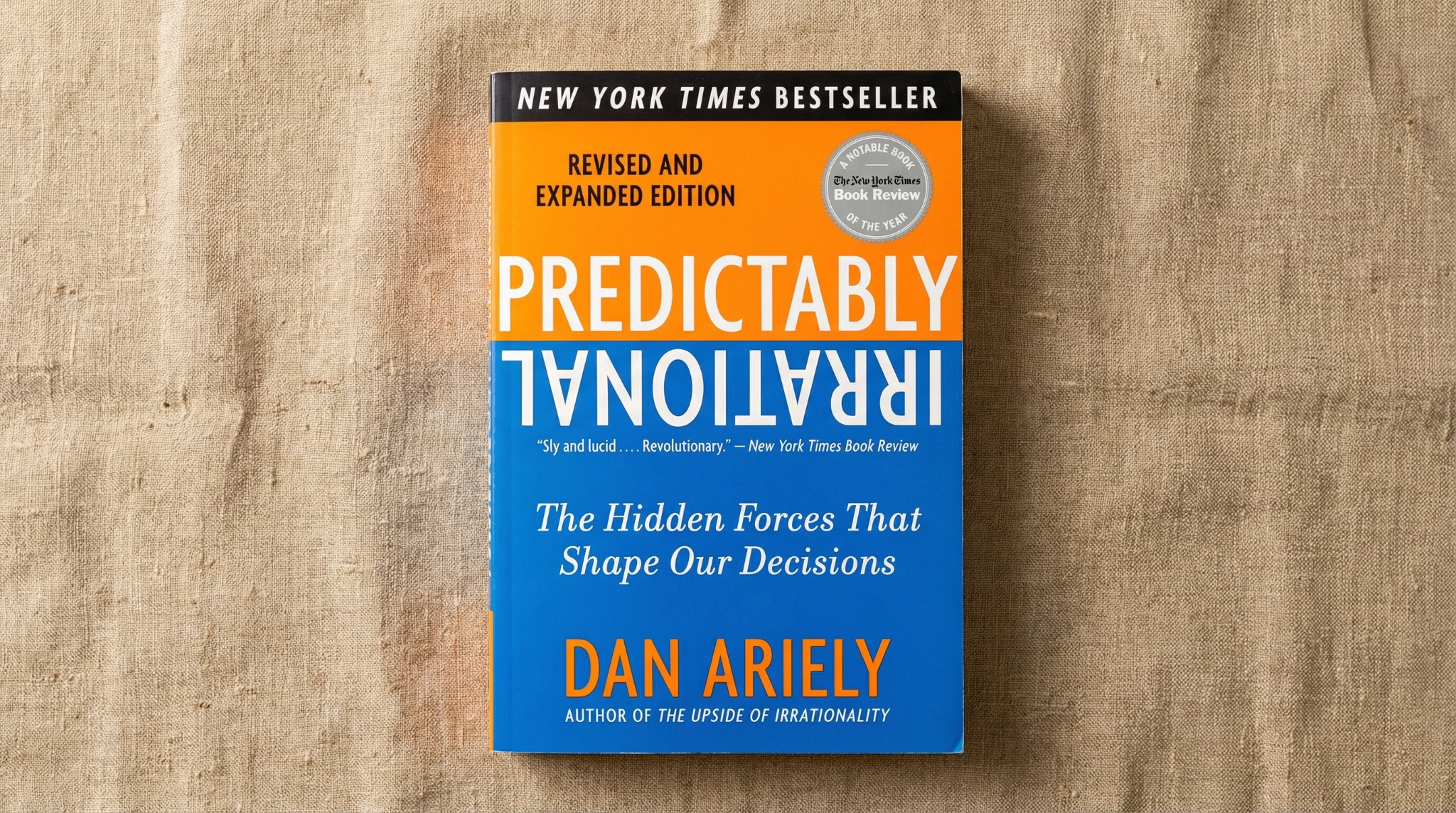
"Our choices are shaped by patterns that are consistent, repeatable, and often invisible to us. Ariely makes irrationality look normal rather than exceptional."
Get This Book
Available on Amazon
Buy on AmazonListen on AudibleAs an Amazon Associate I earn from qualifying purchases.
Our Verdict
RecommendedKey Takeaways
- People make decisions by comparison, not by absolute value — context and framing shape choice before the decision even begins.
- Free has unusual psychological power and can distort judgment, acting as a behavioral trigger rather than just a discount.
- Emotions can overpower long-term intentions in predictable ways — good systems should account for this, not ignore it.
- Social norms and market norms operate differently and should not be mixed carelessly, or trust breaks down.
- Ownership increases perceived value even when it should not — the endowment effect traps people in habits that no longer serve them.
- Human irrationality is systematic, which means it can be understood, anticipated, and designed around.
Full Review
Why Smart People Make The Same Mistakes
Predictably Irrational is Dan Ariely's clear-eyed case against the idea that people make decisions in a fully rational way. He argues that our choices are shaped by patterns that are consistent, repeatable, and often invisible to us. The book is less about exposing human weakness than about explaining how behavior really works.
Ariely's strength is that he turns abstract behavioral economics into everyday language. He shows how people compare options, respond to price signals, overvalue ownership, and make choices that feel logical in the moment but look flawed in hindsight. The result is a book that is both accessible and unsettling, because it makes irrationality look normal rather than exceptional.
Relative Thinking
One of the book's most important ideas is that people judge things comparatively, not in isolation. We rarely know the absolute value of something. Instead, we compare it with what is around it. That means context shapes choice far more than we usually admit.
Ariely uses this to explain why small changes in presentation can shift behavior. A decoy option can make a target option look more attractive. A price anchor can change what people consider expensive or cheap. These effects are not random. They are predictable responses to how the mind processes contrast and reference points.
For operators, that matters because value is often designed, not discovered. How a product, offer, or service is framed can shape the decision before the decision even begins. The book is a reminder that perception is part of the product.
The Power Of Free
Ariely treats free as one of the most powerful forces in human behavior. People often react to free items emotionally rather than economically. Once something is free, the normal tradeoff between cost and benefit changes dramatically.
That insight explains why offers that look trivial on paper can create outsized demand. Free can distort judgment because it feels like a no-risk choice. But Ariely shows that free is not always costless. It can distract people from hidden tradeoffs, future commitments, or lower quality outcomes.
The larger point is that people do not just evaluate value. They respond to the psychology of value. In business, that means a zero price can be more than a discount. It can be a behavioral trigger.
Emotions And Self-Control
Another major theme is how emotion changes decision making. Ariely shows that people behave one way when calm and another way when in a hot state of arousal, stress, or urgency. The gap between intention and action is one of the book's central concerns.
He uses this to explain why people make commitments they later fail to keep. In the cool state, they believe they will act rationally in the future. In the hot state, immediate feeling overrides long term intention. This applies to spending, relationships, health, and risk. The pattern is painfully familiar because it is built into human nature.
The practical lesson is that good systems should not rely on perfect self-control. They should account for predictable lapses. Good design often means making the desirable action easier when judgment is weakest.
Social Norms And Market Norms
Ariely also draws a sharp line between social norms and market norms. Social norms are based on reciprocity, fairness, and relationships. Market norms are based on prices, compensation, and direct exchange. Mixing the two can create confusion and tension.
This is one of the book's most useful ideas because it applies far beyond consumer behavior. People respond differently when they feel they are part of a community versus when they feel they are in a transaction. If a business treats a relationship like a commodity too early, it can weaken trust. If it expects social goodwill inside a market exchange, it can create resentment.
The distinction helps explain why some offers feel generous and others feel cheap, even if the economics are similar. Ariely shows that people are not just buying outcomes. They are also buying context, dignity, and meaning.
Ownership And Loss
The endowment effect is another key idea in the book. Once people own something, they tend to value it more highly than they did before owning it. Ownership changes perception. It makes objects, roles, and choices feel more important than they did from the outside.
This matters because it explains why people resist change even when change would be rational. They overvalue what they already have. They also fear loss more than they value equivalent gain. That asymmetry can trap individuals and organizations in habits that no longer serve them.
For leaders, the lesson is simple but difficult: attachment is not proof of value. People defend what they own because ownership feels like evidence. Ariely shows that this feeling can be deeply misleading.
Why The Book Lasts
Predictably Irrational has lasted because it is practical. It does not just describe bias. It gives readers a vocabulary for recognizing it in themselves and others. That makes it useful in business, policy, marketing, and everyday life.
The book is also strong because it avoids the tone of superiority. Ariely does not present irrationality as something that happens to other people. He presents it as a universal feature of being human. That makes the book more credible and more useful. If everyone is vulnerable, then everyone can learn.
Its real value is not that it makes us more cynical. It makes us more alert. Once you understand the forces shaping choice, you can design better systems, make cleaner decisions, and avoid some of the traps that catch people repeatedly.
Final Thoughts
Predictably Irrational is one of the most accessible and genuinely useful books in behavioral economics. Ariely writes with clarity and wit, and his experiments are consistently illuminating. For leaders, marketers, and anyone designing systems that involve human decision-making, the book is essential. It does not just explain why people behave irrationally. It gives you the tools to account for it.
Enjoyed this review?
Subscribe for more curated book recommendations and insights from the 200 books journey.
No spam. Unsubscribe anytime.
Get This Book
Available on Amazon
Buy on AmazonListen on AudibleAs an Amazon Associate I earn from qualifying purchases.
Our Verdict
RecommendedAlso Worth Exploring
Tools and services I use and recommend.
Some links are affiliate links. I only recommend things I genuinely use.
Get Book Recommendations
Weekly picks from the 200 books journey.
No spam. Unsubscribe anytime.
Keep Reading
Read Next
More from Psychology worth your time


Reader Reviews
No reviews yet. Be the first to share your thoughts!