
Save books, track your reading goal, and leave reviews. Free to join.
Create free account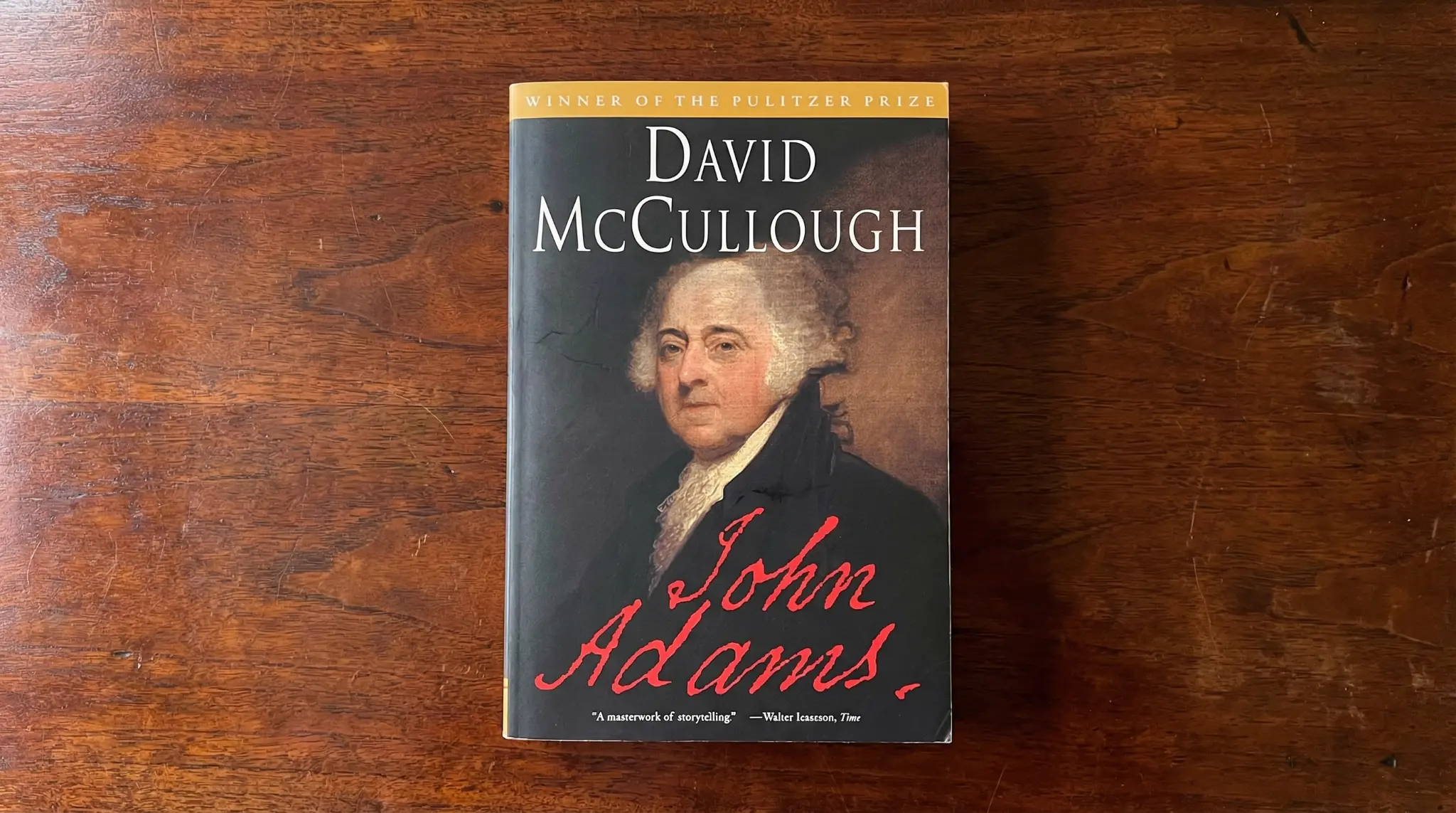
"A portrait of independence, conviction, and loneliness. McCullough presents Adams as brilliant, stubborn, principled, often misunderstood, and deeply human — essential to the American founding and yet repeatedly overshadowed by more charismatic figures."
Get This Book
Available on Amazon
Buy on AmazonListen on AudibleAs an Amazon Associate I earn from qualifying purchases.
Key Takeaways
- John Adams was a central force in the American founding, not a peripheral figure.
- His brilliance was matched by stubbornness, which helped and hurt him.
- The marriage to Abigail was a partnership of intellect, loyalty, and endurance.
- Adams's diplomacy mattered as much as his speeches and arguments.
- His presidency reflects the challenge of governing through division and uncertainty.
- The Adams-Jefferson relationship gives the biography much of its emotional depth.
Full Review
John Adams is David McCullough's sweeping biography of America's second president, but it is really a study of character under pressure. McCullough presents Adams as brilliant, stubborn, principled, often misunderstood, and deeply human. The book traces his rise from provincial lawyer to revolutionary leader to president, while also giving equal weight to his marriage, failures, and private life.
What makes the biography memorable is its refusal to flatten Adams into a monument. McCullough shows him as essential to the American founding and yet repeatedly overshadowed by more charismatic figures like Washington and Jefferson. That tension gives the book its energy. It is about public achievement, but it is also about the cost of being early, blunt, and right when others are not ready to hear it.
Forming a public mind
McCullough begins by showing how Adams developed the habits that shaped his life. He was intensely educated, morally driven, and convinced that argument mattered. As a lawyer, he learned to think in structured, persuasive terms, and that discipline carried into politics. He was not a man of easy charm, but of exact conviction.
That conviction mattered during the revolutionary years. Adams was one of the strongest voices pushing the Continental Congress toward independence. He worked behind the scenes and in debate, helping move the colonies from resistance to rupture with Britain. McCullough makes clear that Adams was not merely present at the founding. He was one of its engines.
The book also shows how lonely that role could be. Adams often found himself in arguments others wanted to avoid or postpone. He saw further than many of his peers, but that did not always earn him gratitude. Instead, it often earned suspicion. The lesson is familiar in any high-stakes environment: being early and correct can still leave you isolated.
The Adams and Abigail partnership
One of the book's greatest strengths is its treatment of the marriage between John and Abigail Adams. McCullough presents it as a partnership of intellect, trust, and emotional steadiness. Abigail is not a supporting character. She is a force in her own right, sharper in some respects than her husband, and often the clearer-eyed observer of political and personal events.
Their letters reveal a relationship built on respect as much as affection. During Adams's long absences in Europe and public life, Abigail managed the household and raised their children, including John Quincy Adams, while also serving as his most trusted confidant. The marriage gives the book warmth, but it also deepens its understanding of what endurance requires.
McCullough makes the case that Adams's private life was not separate from his public life. His decisions were shaped by obligation, loyalty, and domestic sacrifice. In that sense, the biography reads not just as history but as a reminder that serious leadership often depends on the unseen work of relationships behind the scenes.
Revolution and diplomacy
The revolutionary sections are among the most compelling in the book. Adams emerges as tireless, argumentative, and indispensable. He helped select George Washington to lead the Continental Army, advocated for independence, and then moved into the harder work of diplomacy. McCullough details Adams's service in Europe with particular admiration, especially his efforts in France, the Netherlands, and Britain on behalf of the young republic.
These chapters show Adams as a man willing to do difficult, unglamorous work. He was not merely a public speaker. He was a negotiator, strategist, and envoy in hostile settings. McCullough captures the grind of that work and the frustration Adams felt when he was not fully appreciated for it. His success was often measured in what did not go wrong, which is its own kind of achievement.
The book is especially strong when it shows how Adams's stubbornness could be both strength and liability. His independence of mind made him invaluable in moments that required conviction. But it also made him harder to manage, harder to flatter, and easier to isolate. McCullough does not hide that tension. He treats it as part of the cost of character.
Presidency and judgment
McCullough's portrait of Adams's presidency is more restrained, but it remains persuasive. Adams governed in an environment of faction, anxiety, and international tension. He is credited with helping the United States avoid a disastrous war with France, even as his administration became defined by internal division and the Alien and Sedition Acts.
What stands out is Adams's willingness to put the country ahead of his own political popularity. That choice did not always serve him well. He lost political support and eventually the presidency to Jefferson. But McCullough frames this less as failure than as evidence of a leader trying to govern in a moment when stability mattered more than applause.
There is a useful lesson here. Good leadership is not always rewarded in real time. Sometimes the right decision creates immediate resistance. Adams's presidency shows how hard it is to distinguish between political weakness and moral restraint when the stakes are high.
Adams and Jefferson
The relationship between Adams and Jefferson gives the biography one of its richest emotional arcs. They were allies in the founding era and later rivals, shaped by different instincts about power, government, and temperament. McCullough uses their friendship and estrangement to dramatize the broader ideological tensions of the early republic.
What makes this thread compelling is that it is never just political. It is personal, intellectual, and emotional all at once. Two men who helped create a nation also struggled to understand each other's motives. Their conflict reveals how often history is shaped by character as much as principle.
Eventually, the old enemies reconcile in old age through correspondence that is among the most moving in American history. McCullough treats that reconciliation as a kind of grace note, a final proof that great lives can end with humility as well as pride. It is one of the book's most humane threads.
Why it endures
John Adams endures because McCullough makes history feel personal without making it small. The book is deeply researched, but it is also readable, rhythmic, and alive to drama. Adams comes across as a man of severe principle, impressive intellect, and unforgettable stubbornness, but never as a statue.
The biography also succeeds because it is about more than one man. It is about independence, governance, marriage, ambition, and the burden of building institutions from scratch. McCullough shows that the founding was not clean or easy. It was made by flawed people trying to do something larger than themselves.
For readers who value leadership, resilience, and the difficulty of staying principled under pressure, the book offers a great deal. Adams is not always likable, but he is consistently interesting. McCullough understands that a great biography does not need to flatter its subject. It needs to reveal him.
Final Thoughts
John Adams is one of the great presidential biographies because it treats its subject with both admiration and honesty. David McCullough shows a man who helped build a nation, paid heavily for his convictions, and left behind a record of courage under pressure. It is a substantial book, but it never feels detached from the human stakes that made Adams worth writing about.
Enjoyed this review?
Subscribe for more curated book recommendations and insights from the 200 books journey.
No spam. Unsubscribe anytime.
Get This Book
Available on Amazon
Buy on AmazonListen on AudibleAs an Amazon Associate I earn from qualifying purchases.
Also Worth Exploring
Tools and services I use and recommend.
Some links are affiliate links. I only recommend things I genuinely use.
Get Book Recommendations
Weekly picks from the 200 books journey.
No spam. Unsubscribe anytime.
Keep Reading
Read Next
More from Biography & Memoir worth your time


Reader Reviews
No reviews yet. Be the first to share your thoughts!