
Save books, track your reading goal, and leave reviews. Free to join.
Create free account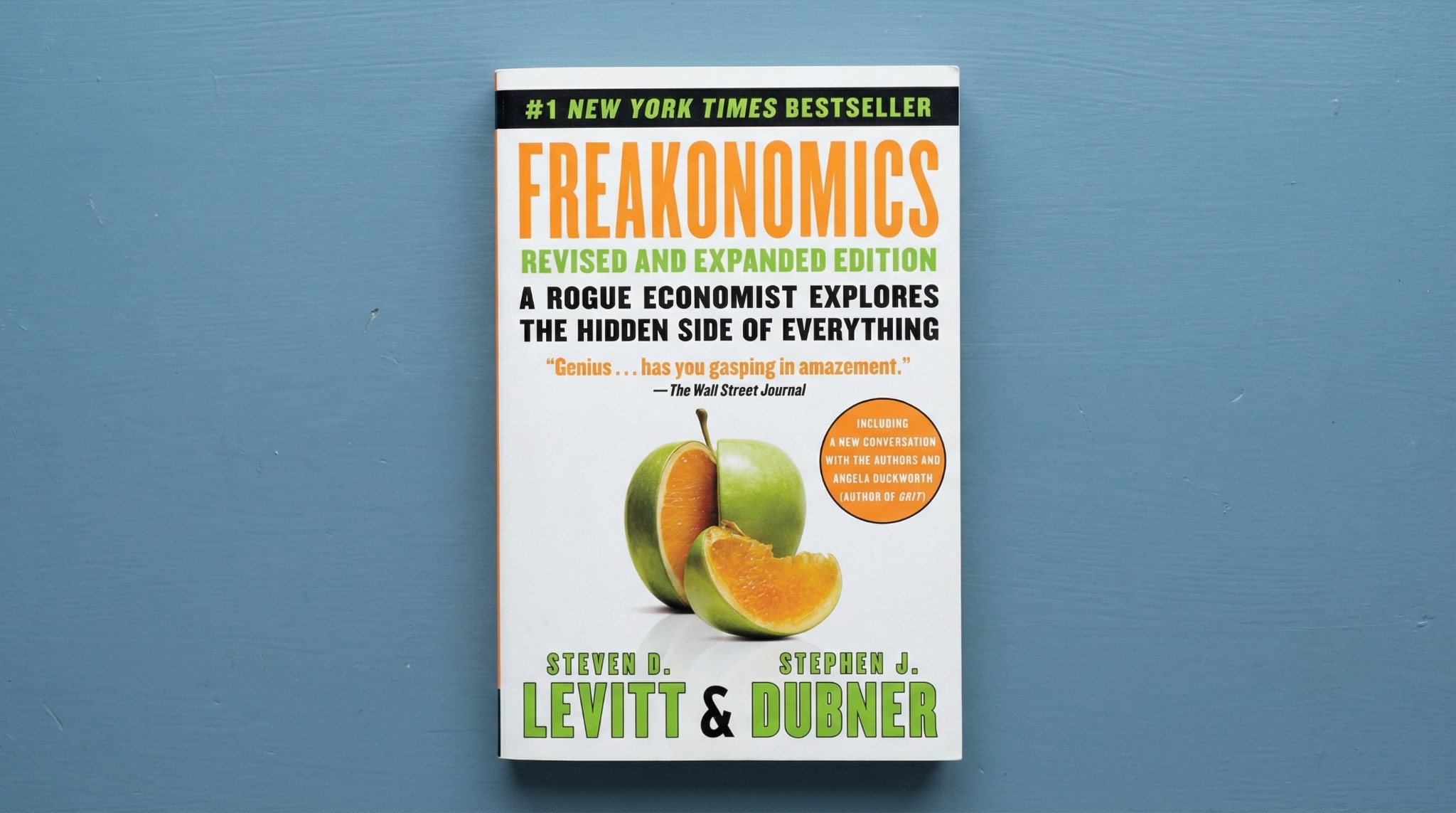
"Levitt and Dubner apply economic thinking to everything from sumo wrestling to crime rates, revealing that incentives drive behavior in ways that conventional wisdom consistently gets wrong."
Get This Book
Available on Amazon
Buy on AmazonListen on AudibleAs an Amazon Associate I earn from qualifying purchases.
Our Verdict
RecommendedKey Takeaways
- Incentives shape behavior more powerfully than people usually admit.
- Conventional wisdom is often a story people tell, not a reliable description of reality.
- Hidden causes can produce major outcomes far from the surface-level event.
- Experts often have incentives of their own, so authority should be examined, not assumed.
- Economic thinking can be applied far beyond markets and money.
- The book's real value is teaching readers to question easy answers and look for structures underneath behavior.
Full Review
Why Incentives Explain More Than We Think
Freakonomics is a sharp, playful book about using economics to explain behavior that usually gets described in moral or emotional terms. Steven Levitt and Stephen J. Dubner argue that people respond most strongly to incentives, and that many "obvious" explanations for human behavior turn out to be wrong once you look closely at the data. The book is less a conventional economics text than a series of surprising case studies that teach readers to question common assumptions.
The power of the book is in its method. Levitt and Dubner take topics that seem unrelated to economics — cheating in school, sumo wrestling, crime, names, and parenting — and ask what hidden structures shape the outcome. That approach makes the book feel like a detective story. The answer is rarely what people expect, and that is the point.
Incentives Drive Behavior
The first and most important idea in the book is that incentives are everywhere. People do not just respond to money. They also respond to social approval, fear, status, guilt, and prestige. Levitt and Dubner use that lens to explain why behavior often looks irrational until the incentive structure is revealed.
Their examples are memorable because they expose the gap between what people say and what they do. Teachers may cheat on standardized tests when they are pressured by weak evaluation systems. Sumo wrestlers may collude when winning creates a stronger payoff than fair competition. The lesson is not that people are bad. It is that systems shape behavior in predictable ways.
For operators, this is one of the book's most enduring lessons. If you want different behavior, change the incentives, not just the slogans. Most organizations fail when they confuse stated values with actual reward structures.
Conventional Wisdom Is Often Wrong
Freakonomics makes a habit of attacking widely held beliefs. Some of them are harmless myths. Others affect policy, education, and public trust. The authors show that once you follow the data instead of the narrative, many comforting assumptions fall apart.
One of the most famous examples is the section on parenting. The book argues that parents matter deeply in emotional and moral ways, but less than people think in determining long-term outcomes like academic success or delinquency. That does not mean parents are irrelevant. It means that some of the most dramatic differences among children come from peer groups, early environment, and factors outside parental control.
Another major example is the link between names and destiny. The book explores how names can shape perception and opportunity, but not in the simplistic way self-help culture often suggests. The larger message is that people love tidy stories because they feel intuitive, but reality is usually more complicated. Data tends to unsettle those stories.
Hidden Causes And Strange Connections
A big part of the book's appeal is the way it connects seemingly unrelated things. Levitt and Dubner are looking for the hidden mechanism underneath the visible event. They do not start with a conclusion and work backward. They start with a strange question and follow the evidence.
That method leads to some of the book's most interesting chapters. Why are drug dealers still living with their mothers? Because most of them are not making anything close to the money the public imagines. Why did crime fall in the 1990s? The book famously explores several possible causes, including abortion policy, and argues that distant, indirect factors can have major effects years later.
This style is useful because it teaches readers to think in systems rather than headlines. Outcomes are often produced by long chains of incentives, information gaps, and delayed consequences. The visible story is rarely the whole story.
Experts, Information, And Power
Another recurring theme is that experts often have informational advantages that they use to protect their own position. Realtors, teachers, dealers, and even institutions can all shape facts in their favor when the people they serve do not have equal access to the information. That asymmetry matters.
The book is especially good at showing how easy it is to mistake authority for neutrality. Just because someone is an expert does not mean they are objective. They may be responding to the incentives of their profession. They may be optimizing for self-interest while appearing to serve the public.
This is where Freakonomics becomes more than a collection of clever anecdotes. It is a warning about blind trust. If you want to understand a system, ask who controls the information, who benefits from the story being told, and what would happen if the incentives changed.
What The Book Gets Right
The best thing about Freakonomics is that it expands people's sense of what economic thinking can do. It makes economics feel less like graphs and more like a tool for understanding real life. That is a valuable contribution, especially for readers who are skeptical of academic language.
It also has strong narrative energy. The chapters move quickly, the examples are vivid, and the authors know how to make an analytical point without burying it in jargon. That makes the book unusually readable for a work of ideas. It works because it keeps asking good questions.
For leaders, the book is a reminder that systems matter more than intentions. Most organizational failures are not caused by one bad person. They are caused by badly designed incentives that encourage the wrong behavior. If you fix the structure, you often fix the outcome.
Limitations And Critiques
The book's strength is also its limitation. Its examples are so compelling that readers can come away thinking everything can be reduced to incentives and data. That is too neat. Human behavior is messier than that. Culture, identity, history, and emotion all matter, sometimes in ways that are hard to measure.
Some of the book's arguments also rely on provocation. The point is often to surprise, and surprise can flatten nuance. Not every chapter lands equally well, and some of the claims have been debated over time. Still, the broader framework remains valuable even where specific conclusions are contested.
A fair reading is that Freakonomics does not explain everything. It explains enough to make you suspicious of simplistic explanations. That alone is useful. It trains the reader to ask better questions.
Final Thoughts
Freakonomics is a smart, entertaining book that helped popularize a way of thinking rather than a set of facts. Its lasting contribution is the habit it encourages: look past the obvious explanation, follow the incentives, and ask what is really driving the result. For readers interested in business, leadership, or human behavior, that mindset remains powerful.
Enjoyed this review?
Subscribe for more curated book recommendations and insights from the 200 books journey.
No spam. Unsubscribe anytime.
Get This Book
Available on Amazon
Buy on AmazonListen on AudibleAs an Amazon Associate I earn from qualifying purchases.
Our Verdict
RecommendedAlso Worth Exploring
Tools and services I use and recommend.
Some links are affiliate links. I only recommend things I genuinely use.
Get Book Recommendations
Weekly picks from the 200 books journey.
No spam. Unsubscribe anytime.
Keep Reading
Read Next
More from Finance & Investing worth your time


Reader Reviews
No reviews yet. Be the first to share your thoughts!