
Save books, track your reading goal, and leave reviews. Free to join.
Create free account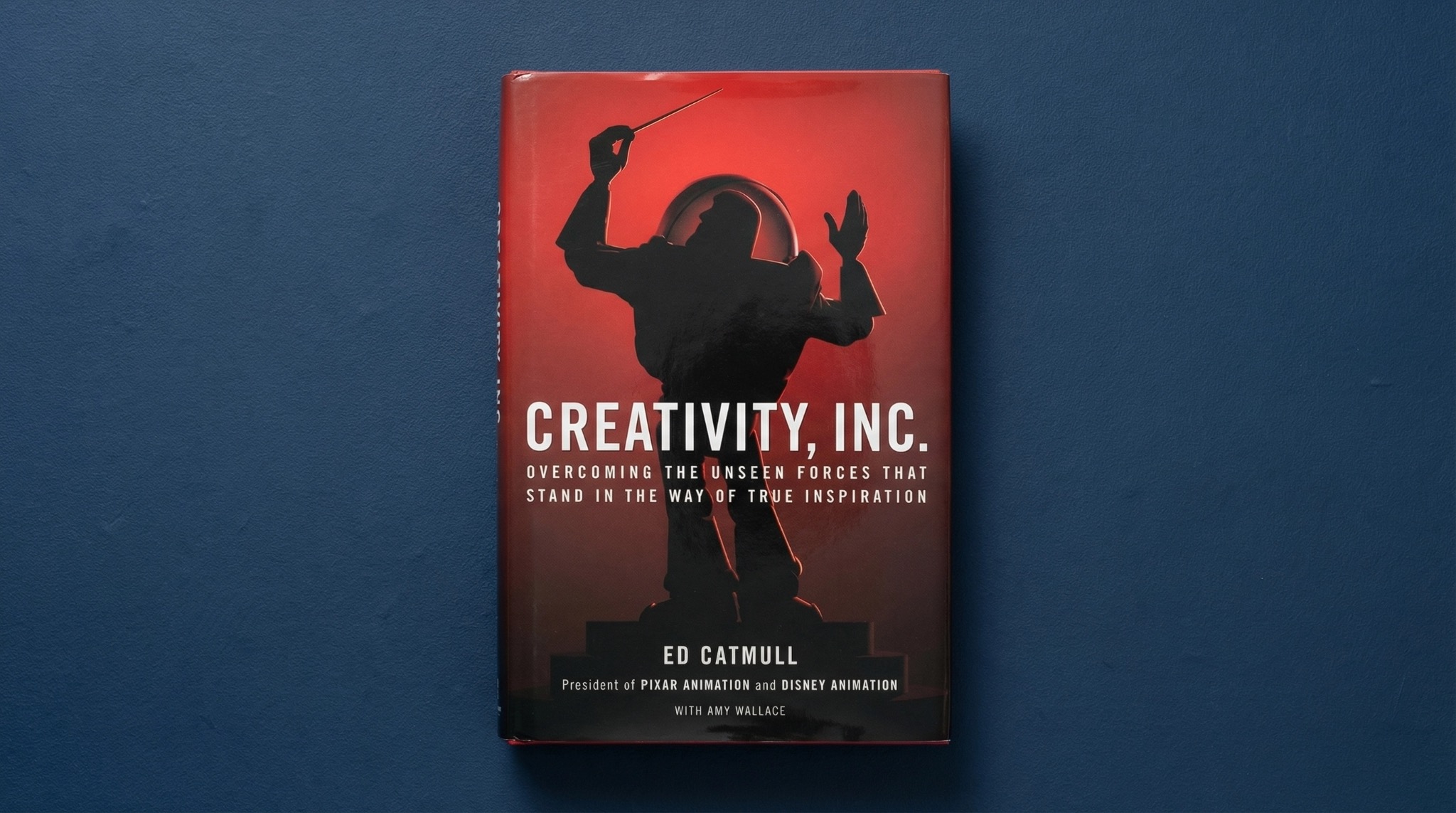
"Ed Catmull's inside account of how Pixar built a culture that protects original thinking — through candor, structured feedback, and the discipline to make failure useful rather than something to hide."
Get This Book
Available on Amazon
Buy on AmazonListen on AudibleAs an Amazon Associate I earn from qualifying purchases.
Our Verdict
EssentialKey Takeaways
- Creativity is not a gift that appears on its own. It must be protected by culture and structure.
- The Braintrust works because it creates candid feedback without managerial control.
- People should feel safe criticizing the work without feeling they are attacking the person.
- Failure is only wasteful when the organization refuses to learn from it.
- Hierarchy can destroy candor if rank matters more than truth.
- Collaboration works best when it encourages friction without letting ego take over.
- Leaders should focus less on having answers and more on creating conditions for good ideas to emerge.
Full Review
How Pixar Built a Culture That Protects Original Thinking
Creativity, Inc. is Ed Catmull's account of how Pixar learned to protect creativity inside a real business, with deadlines, budgets, failures, and egos. It is part memoir, part management book, and part operating manual for any organization that wants original work without turning chaos into a permanent state. Catmull's central argument is that creativity is not a mysterious flash of genius. It is a system that must be defended.
The book matters because Pixar's success was never just about talent. Plenty of studios had smart people and expensive tools. Pixar's edge came from culture, and more specifically from the habits, structures, and conversations that allowed bad ideas to be surfaced early, good ideas to be improved fast, and people to tell the truth without fear. Catmull shows that excellence in creative work depends on making candor safe and failure useful.
The story starts before Pixar became Pixar, with Catmull's early obsession with computer graphics and the long road through technical setbacks, financial pressure, and a series of near misses. He describes how the company was born out of hope, but survived because it learned how to work together under uncertainty. That combination of ambition and humility is the book's real subject.
Creativity Needs Protection
One of the book's strongest ideas is that creativity is fragile. It does not just happen because talented people are placed in a room. In fact, talented people can easily create an environment where ideas get crushed, protected too long, or filtered through hierarchy before they are truly ready. Catmull argues that organizations often damage creativity without realizing it.
That is why Pixar built mechanisms to surface truth early. The most famous is the Braintrust, a group of trusted peers who review work and give blunt feedback without authority to impose decisions. The purpose is not to command the filmmaker, but to expose the problems in the story while the project is still fixable. That distinction is crucial. Good creative organizations create room for honesty without turning feedback into control.
Catmull also stresses that people are not their projects. That sounds simple, but it changes everything. When creators feel personally attacked by criticism of the work, they defend the wrong thing. The Braintrust succeeds because it separates the person from the problem. That allows honest critique without humiliation, which is rare in most workplaces and nearly impossible in organizations that confuse politeness with excellence.
Failure Is Part Of The Process
Pixar's success is often told through its hits, but Catmull is more interested in the failures that made those hits possible. He argues that failed projects are not waste if they generate learning. The real danger is not failure itself, but organizations that punish it so harshly that people stop taking risks or hide problems until it is too late.
Toy Story 2 is one of the book's most powerful examples. During production, the film was nearly lost when a catastrophic mistake wiped out much of the work. The crisis could have broken the studio. Instead, the team recovered, rebuilt, and in the process deepened its understanding of how fragile creative production really is. Catmull uses this and similar stories to show that resilience matters as much as talent.
This is where the book gets very practical. Leaders need systems that assume mistakes will happen and make sure they are discovered early. That means encouraging bad news, rewarding honesty, and resisting the urge to look polished too soon. A creative organization that hides error is already in trouble. Pixar's advantage came from making it normal to say the thing that was not working.
Hierarchy Can Kill Candor
Catmull is suspicious of hierarchy when it interferes with truth. He does not argue that leadership is unnecessary. He argues that leadership becomes dangerous when it prevents people from speaking honestly. In many companies, titles create distance, and distance creates fake agreement. People learn to tell the boss what they think the boss wants to hear.
At Pixar, Catmull worked to lower that barrier. He wanted people to challenge each other's assumptions and ideas regardless of rank. That is hard because most workplaces are built to reward deference. But if the goal is original work, deference can become a liability. The best idea in the room should win, not the most senior voice.
This is one of the reasons the Braintrust became so important. It created a space where people could be direct without being destructive. That is harder than it sounds. Too much softness and the feedback is useless. Too much force and people become defensive. Pixar's culture tried to stay in the middle, where criticism was honest, specific, and aimed at the work itself.
For operators, this is a powerful lesson. If people only speak freely in private and perform agreement in public, your organization is not really aligned. It is merely compliant.
Talent, Collaboration, And Friction
Creativity, Inc. also pushes back on the myth of the lone genius. Catmull is clear that Pixar's great work came from collaboration, not individual brilliance alone. That does not mean committees create magic. It means that original work requires many minds working against the same problem from different angles, with enough trust to disagree openly.
The book shows that collaboration is not frictionless. In fact, good collaboration produces friction on purpose. If everyone agrees too quickly, the work usually suffers. Creative teams need disagreement, but they also need a way to absorb it without ego taking over. Catmull's point is that organizations should design for productive conflict, not pretend conflict will disappear if everyone is nice.
This matters because talent often creates its own problems. Smart people can become territorial, perfectionist, or fragile. They may defend their own ideas rather than the best idea. Catmull's answer is not to hire less talent, but to build a culture that channels talent toward the work, not toward status. The standard is whether the team is making the project better, not whether any one person gets credit.
Learning To Manage The Unseen
The subtitle of the book refers to the unseen forces that stand in the way of inspiration. Catmull's real subject is all the invisible things that derail creative work: fear, overconfidence, bad communication, hierarchy, complacency, and false certainty. Most of these cannot be solved with a single policy. They have to be managed continuously.
He is especially good on the idea that organizations drift. Even Pixar, with all its talent and early success, had to guard against becoming rigid or self-satisfied. Once a company believes it has figured out creativity, it is already in danger. The book is full of examples of Catmull and his team trying to keep the culture adaptive, curious, and open to correction.
There is also a strong sense that leadership in creative organizations is less about having answers than about setting conditions. Catmull does not present himself as a visionary who could see the future perfectly. He presents himself as someone who tried to build a structure that would let good ideas survive. That is a more useful model for most leaders anyway.
What Leaders Can Steal
For executives, founders, and team builders, Creativity, Inc. is one of the best books on culture and candor. Its lessons are especially relevant in environments where quality depends on iteration and trust. If people cannot tell the truth early, the cost arrives later, usually in the form of bad products, missed deadlines, or unspoken dysfunction.
The Braintrust is the clearest transferable idea. Put smart people in a room, ask them to identify the problems, and keep authority separate from feedback. That model works because it values insight over hierarchy. It is a reminder that the best organizational systems are often the ones that make it easiest to surface reality.
The deeper lesson is that creativity is not fragile because people are weak. It is fragile because organizations are naturally designed to suppress risk, smooth conflict, and protect ego. Catmull shows that if you want original work, you have to build a culture that resists those instincts instead of rewarding them.
Final Thoughts
Creativity, Inc. is one of the strongest books on how to lead creative organizations without suffocating them. Ed Catmull explains Pixar's success in a way that is both human and operational, showing that great culture is designed, defended, and constantly renewed. It is especially valuable for leaders who need to combine high standards with openness, and for anyone trying to build something original without losing the truth along the way.
Enjoyed this review?
Subscribe for more curated book recommendations and insights from the 200 books journey.
No spam. Unsubscribe anytime.
Get This Book
Available on Amazon
Buy on AmazonListen on AudibleAs an Amazon Associate I earn from qualifying purchases.
Our Verdict
EssentialAlso Worth Exploring
Tools and services I use and recommend.
Some links are affiliate links. I only recommend things I genuinely use.
Get Book Recommendations
Weekly picks from the 200 books journey.
No spam. Unsubscribe anytime.
Keep Reading
Read Next
More from Business & Leadership worth your time


Reader Reviews
No reviews yet. Be the first to share your thoughts!