
Save books, track your reading goal, and leave reviews. Free to join.
Create free account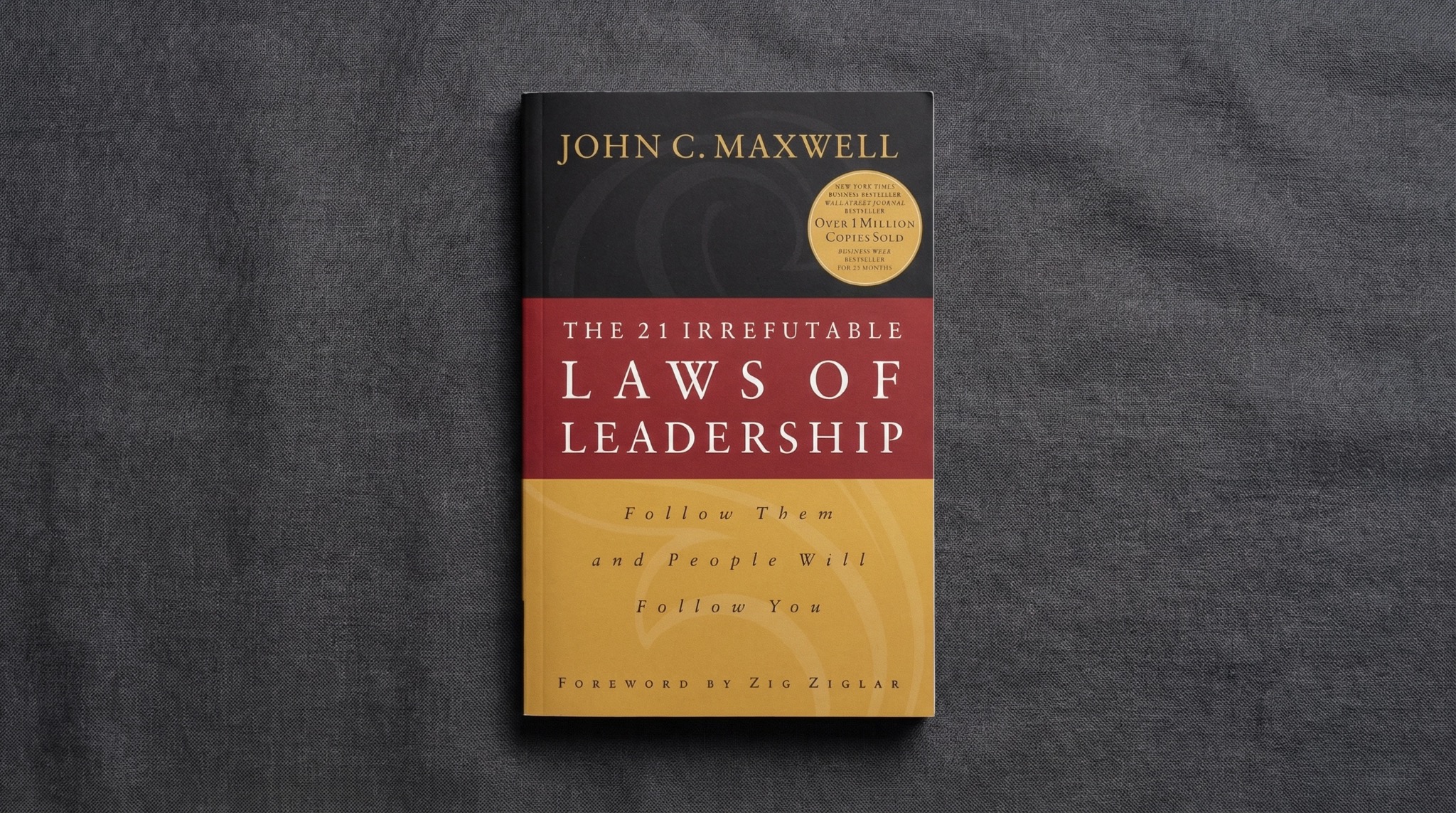
"Maxwell's twenty-one laws turn leadership into a practical discipline. The core argument: leadership is influence, not position, and every leader has a lid that determines the ceiling of their effectiveness."
Get This Book
Available on Amazon
Buy on AmazonListen on AudibleAs an Amazon Associate I earn from qualifying purchases.
Our Verdict
Worth ReadingKey Takeaways
- Leadership is influence, not position.
- Every leader has a lid — improving leadership raises the ceiling on everything else.
- Trust is the foundation of all effective leadership.
- Leadership develops through daily practice, not sudden transformation.
- Great leaders add value, build strong inner circles, and prioritize what matters most.
- Timing, momentum, and sacrifice are all real parts of leadership, not side issues.
- Legacy is the final test of whether leadership was meaningful and durable.
Full Review
Leadership Principles That Compound Over Time
The 21 Irrefutable Laws of Leadership is John Maxwell's attempt to turn leadership into a practical discipline instead of a vague personality trait. The book argues that leadership is not the same as position, and that influence is what actually matters. Maxwell organizes the subject into twenty-one laws, each meant to describe a pattern that leaders ignore at their peril and use at their advantage.
The core idea is straightforward: leadership is a force multiplier. If your leadership improves, everything around you improves with it. If it is weak, your team, organization, or project will hit an invisible ceiling. Maxwell calls this the Law of the Lid, and it sets the tone for the rest of the book. Leadership ability determines the effectiveness of everything else you do.
Maxwell writes from a lifetime of teaching and observing leaders, so the book feels less like theory and more like a field manual. It is broad rather than deep, but that is part of its appeal. He wants the reader to see leadership as a set of repeatable laws that can be learned, practiced, and applied in many settings.
Influence And The Lid
The first law is the Law of the Lid. Your leadership capability places a ceiling on your effectiveness. A talented person with weak leadership will always underperform a less gifted person with stronger leadership. This is one of Maxwell's most useful ideas because it reframes growth as a leadership problem, not just a technical one.
The Law of Influence follows naturally. Leadership is influence, nothing more and nothing less. You do not become a leader by title, appointment, or self-declaration. You become one when people choose to follow. That makes trust, credibility, and consistency central, because influence cannot be forced for long.
Maxwell also emphasizes that leadership is not static. You can raise your lid through learning, experience, and deliberate practice. This is a hopeful claim. It means leadership is not reserved for the chosen few. It is something you can develop if you are willing to work at it, observe yourself honestly, and keep raising your standards.
Process, Navigation, And Addition
The Law of Process says leadership develops daily, not in a day. This is one of the book's most durable ideas. Maxwell treats leadership like compound interest. Small improvements, repeated over time, become significant. That matters because people often want dramatic breakthroughs when the real answer is sustained repetition.
The Law of Navigation says leaders can steer the ship before they can build the ship. A good leader thinks ahead, anticipates obstacles, and plans with enough clarity that others can trust the route. This law is especially useful for executives because it highlights the difference between reacting and guiding. Leaders do not just respond to the future. They help make it legible.
The Law of Addition says leaders add value by serving others. People want to follow someone who makes them better. That means great leaders spend less time asking what they can extract and more time asking what they can contribute. Maxwell's view is practical, not sentimental. Add value consistently and influence grows. Take value consistently and it shrinks.
Magnetism, Connection, And Inner Circle
The Law of Magnetism says that who you are is who you attract. Leaders draw people like themselves, especially in character, attitude, and work ethic. This is both flattering and sobering. If your team lacks energy, discipline, or integrity, Maxwell would say the problem probably starts with the leader's own habits and standards.
The Law of Connection says leaders touch a heart before they ask for a hand. People do not commit fully to abstract missions. They commit to leaders who understand them. Maxwell argues that emotional connection must come before execution. That makes this law especially relevant in sports, where performance depends on trust and shared belief, not just tactics.
The Law of the Inner Circle says a leader's potential is determined by those closest to them. Great leaders build strong teams around themselves, not because they are weak, but because they are smart enough to know they cannot do everything alone. The inner circle should complement weaknesses, sharpen judgment, and make the leader more effective than they could be on their own.
Trust, Timing, And Momentum
The Law of Solid Ground says trust is the foundation of leadership. Without trust, nothing else holds. Maxwell is blunt here. Leaders earn trust through competence and character, and lose it quickly through inconsistency or self-serving behavior. This law underpins the rest of the book because all influence depends on it.
The Law of Timing says the right action at the wrong time is the wrong action. Leadership is not only about what to do, but when to do it. That is a useful corrective for people who mistake decisiveness for wisdom. Good timing requires patience, a read on the situation, and the ability to wait until conditions are right.
The Law of Momentum says a little success can fuel more success. Maxwell treats momentum as one of the most powerful assets in leadership. It creates belief, energy, and confidence, which then make future wins easier. Leaders need to notice it, protect it, and build systems that keep it moving rather than wasting it through hesitation or ego.
Priorities, Sacrifice, And Legacy
The Law of Priorities says activity is not accomplishment. This is one of the most operator-friendly laws in the book. Busy leaders can easily confuse motion with progress. Maxwell's point is that great leaders know what matters most and focus there. Priorities force tradeoffs, and tradeoffs are part of real leadership.
The Law of Sacrifice says you must give up to go up. Leadership carries costs. You sacrifice comfort, time, privacy, and sometimes even personal ambition for the good of the mission and the people. Maxwell does not romanticize this. He presents sacrifice as the price of influence, not a badge of martyrdom.
The Law of Legacy says the measure of leadership is what happens after you leave. That gives the whole book its long horizon. A leader is not merely successful if they get results. They are successful if they create something durable, transferable, and strong enough to outlast them. Legacy is the final test because it reveals whether leadership was real or merely positional.
What It Means For Operators
For executives, coaches, or anyone running a team, the book's usefulness is in its structure. It gives a vocabulary for diagnosing why things are working or failing. Is the lid too low? Is trust missing? Is the inner circle weak? Are you chasing activity instead of outcomes? The laws are simple enough to remember and broad enough to revisit often.
The book also reinforces an important idea about development. You do not become a better leader through a single breakthrough. You become one through repetition, feedback, and alignment between character and behavior. That makes it a good fit for people who want practical self-correction rather than abstract inspiration.
For sports and business alike, the strongest laws are probably influence, trust, addition, and priorities. Those four determine whether a team can absorb pressure and keep moving. Maxwell's bigger point is that leadership is less about title and more about whether people choose to follow because your presence makes the journey better.
Final Thoughts
The 21 Irrefutable Laws of Leadership is broad, practical, and easy to return to when you want a simple framework for thinking about leadership. It is not the most nuanced leadership book ever written, but it is one of the most usable. Maxwell's ideas work because they are memorable, repeatable, and grounded in patterns leaders actually encounter. For someone running teams or building influence, it is a solid manual for thinking clearly about what leadership requires and why it matters.
Enjoyed this review?
Subscribe for more curated book recommendations and insights from the 200 books journey.
No spam. Unsubscribe anytime.
Get This Book
Available on Amazon
Buy on AmazonListen on AudibleAs an Amazon Associate I earn from qualifying purchases.
Our Verdict
Worth ReadingAlso Worth Exploring
Tools and services I use and recommend.
Some links are affiliate links. I only recommend things I genuinely use.
Get Book Recommendations
Weekly picks from the 200 books journey.
No spam. Unsubscribe anytime.
Keep Reading
Read Next
More from Business & Leadership worth your time


Reader Reviews
No reviews yet. Be the first to share your thoughts!